This is real branding*
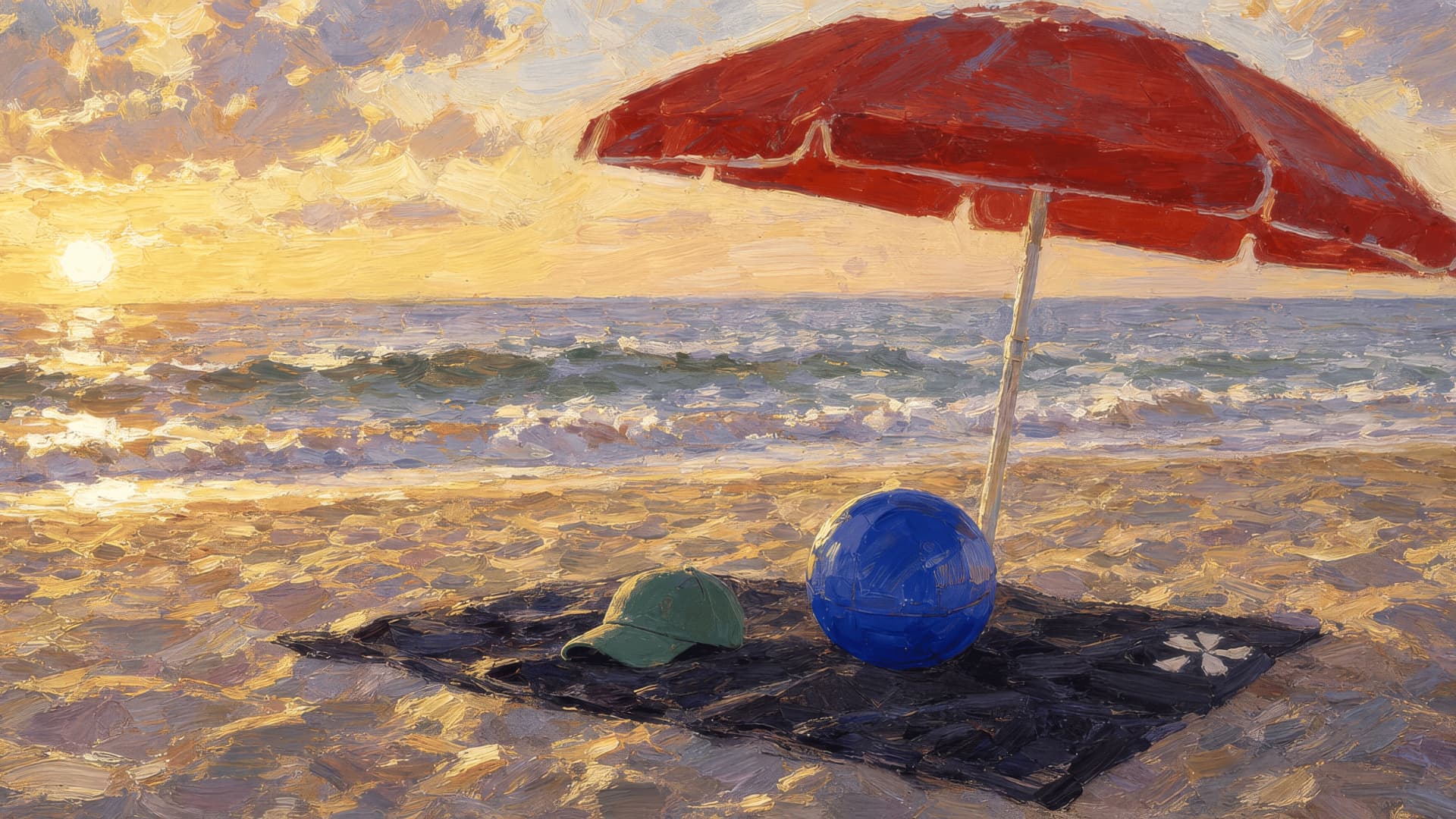
For a month I've been asking the same question: I show a blue ball, a green cap and a red umbrella with no name or logo, and almost nobody gets it wrong. But nobody just says the brand: everyone answers with a memory.
This is real branding*
I've been asking the same question for a month...
I show a photo of a blue ball, a green cap and a red beach umbrella. No name, no logo, no tagline. And I ask which brand they belong to.
I've tried it on social media, at the dinner table, with friends, with my family.
Almost nobody gets it wrong.
But the interesting part isn't that they get it right. It's what happens right after. Nobody just says the brand name. Everyone tells a story. The summer they dived into the water to grab one. Their grandfather's cap. The umbrella they'd been using since before their son was born.
You ask about a brand and they answer with a memory.
That's what I wanted to understand.
And the answer has nothing to do with nostalgia.
Let's start with what they were
The ball.
It was born in Germany in the thirties as the three-dimensional version of the Nivea cream tin. There's a 1934 photo of a swimmer with one under his arm.
It reached Spanish beaches in the seventies, dropped from a small plane. Hundreds of balls per pass, half-inflated so the wind wouldn't blow them away.
And one detail that changes everything:
The plane only flew over each beach once per season.
You couldn't buy it. You didn't know which day it would come.
You could only be there when it flew over.
In 1988 the Coastal Act banned advertising on the beach and plastic in the sea. The plane stopped flying. The ball kept arriving inside cream packs for years, but it no longer fell from the sky.
And without a sky there's no legend.
The cap.
The three-wheat-ear logo was drawn in 1979, by hand and without a computer, for a single Caja Rural branch in Albacete. It was signed by a Croatia-born designer based in Spain, Ante Kvessitch, who also made the logos for Campsa and Alianza Popular.
It was so well liked that it ended up in dozens of rural savings banks across the country.
It has never been sold. It's handed out at branches, according to how many customers each one has. A branding expert explained it in Verne: money can't buy everything, and that also gives them exclusivity.
There's a story that sums this up better than any analysis. A girl from Albacete asked for a cap for her twenty-fifth birthday. Her parents asked the whole town, the family, the neighbours. Her friends scoured Wallapop, found a seller and the seller vanished. In the end one of them found where to get it properly screen-printed.
She called it teamwork.
An entire town mobilized to get hold of a bank's free merch.
The umbrella.
Coca-Cola was the first company in Spain to manufacture bar furniture. It didn't buy a spot on the terrace. It manufactured the whole terrace. The tables, the chairs, the umbrella.
And Spain is a country of bars. Hospitality is 7.4% of GDP. Half a country's social life celebrated under a soft-drink brand's furniture.
They're still made in Castalla, forty minutes from my home. The factory manager put it better than any brand manual: they wanted to transfer the brand's values to a physical object.
You couldn't get it in a shop either. It was handed out to professionals. The beach bar, the village bar, the corner terrace. If you knew someone, you were lucky. And if the bar owner was your friend, one day you'd turn up at home with a gift that didn't seem like much back then.
Over the years you understood what you had.
All three were nearly impossible gifts
Here's what I didn't see until I put the three stories together.
None of the three could be bought.
And none of the three was easy to get.
The ball fell once a year on a beach that wasn't yours. The cap depended on someone at a branch giving it to you. The umbrella, on knowing whoever ran a bar.
Three free objects. Three unreachable objects.
We've been told a thousand times that price sets perceived value. These three prove the opposite. They were free and worth a lot, precisely because there was no way to buy them.
That's what turned them into memory instead of advertising.
And none was designed for what it ended up being
The ball was packaging.
The cap was propaganda for a savings bank.
The umbrella was bar furniture.
None of the three brands was building a cultural icon.
They were solving a commercial problem, and a rather prosaic one.
People added the meaning afterwards. Decades afterwards.
The uncomfortable part
At some point, all three brands lost control of their own objects.
Clara Nuño wrote it in Revista Salvaje about the cap: a logo that took on a life of its own and that the institution couldn't get rid of, even though it wanted to.
Even though it wanted to.
It's not a pretty phrase, it's a documented fact. Several banks changed logos and colours in their mergers to look like modern banks, and they all ended up going back to the wheat ear. They couldn't let it go.
Today there are Instagram filters, memes and Simpsons keyrings wearing the cap. People paying fifty euros for a second-hand one. A guy from Zamora turned up with his at an electronic music festival in Amsterdam and ended up photographing twenty attendees from around the world posing with it. What struck them most, he said, was that a bank's logo had ended up becoming a national symbol.
None of that was done by the bank.
The promotional object ended up having its own merchandise.
And this summer, at Sonorama, it was Caja Rural itself thanking people on social media for bringing the cap to the festival. They called it a cult object. They said people had made it part of the landscape.
A bank thanking people for wearing its advertising.
The same thing happened with the umbrella. A family in Córdoba has had one since 1992. Thirty-three years kept in a cupboard, wrapped in plastic and tied with little strings after every use. It's cleaned, stored and opened the following summer like the first day.
In their house they don't call it an umbrella. They call it the umbrella.
It's one year older than their eldest daughter.
My in-laws have another one in the storage room. They keep it like gold and occasionally let me use it. All around, on the sand, new umbrellas blowing away in the east wind.
There's no comparison.
So, what does a brand control?
If people supply the meaning, and if the object ends up escaping whoever made it, the question is what's left under control.
What's left is what came before. The decisions.
Someone decided to turn a cream tin into a sphere and drop it from a plane. Someone decided to draw three wheat ears by hand for a village savings bank. Someone decided that a soft-drink brand should furnish a country's terraces.
None of those decisions was obvious.
None was the safe option.
None of them shows up in a brief.
And all of them were made without knowing what they'd set off.
We call the trace those decisions leave the Human Signature. It's not a graphic device or a style or a layer added at the end. It's what remains when someone chooses with judgement, discards with intention and knows when to stop.
It's the part of the work you can't see and that decides everything else.
Why I'm writing this now
Because everyone has the tools now.
Today a complete identity is generated in seconds, and fifty more variants if needed. Production is no longer the problem.
What can't be generated is the judgement to decide which of those fifty deserves to exist. Even less, the willingness to make a decision that makes no sense in a spreadsheet, like filling the sky with balls on a single day each year.
Nivea wasn't handing out balls. It was handing out summers.
Caja Rural wasn't handing out caps. It was handing out belonging.
Coca-Cola wasn't giving shade. It was giving a place.
*This is real branding. What's left when you remove the logo.
One last thing
A blue ball. A green cap. A red umbrella.