A shelf of cassettes instead of an open browser tab
We save articles because they interest us; Caset* gives them a voice so they can find their place in the day. Four notes by Victor Carazo on reading, listening and keeping authorship.
We save articles because they interest us, and many end up waiting for a moment that never comes
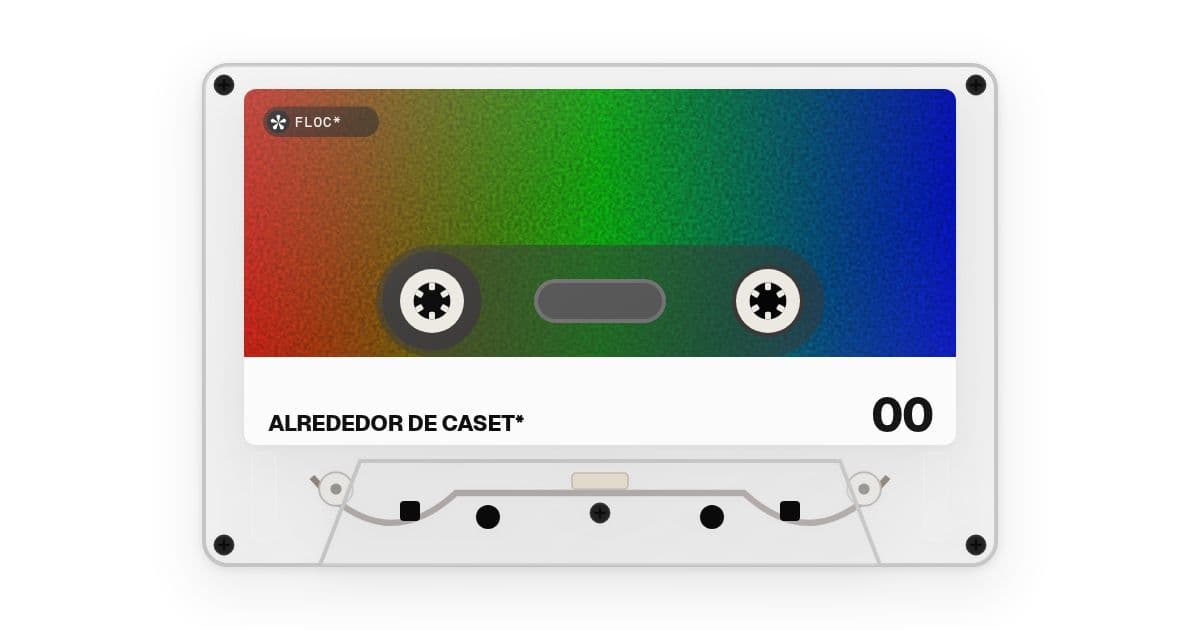
Caset* was born from that distance: giving a voice to what we've already chosen to read, so it can find its place in the day.
Sergio G. Gómez is the one who tells Caset*: that voice is his. I look at it from brand strategy and from the question of how to turn it into a business, and what I see is more than converting text into audio.
It changes the relationship with content: choosing it, saving it, listening to it and coming back to it, the way we did with music. A shelf of cassettes instead of an open browser tab.
That's why it connects with what we do at FLOC*, where we understand strategy, design and technology as parts of a single organism, not three separate services. You can tell in Caset*: the idea, the form, which includes the tape, the shelf and the tone, and the technology that makes it sound all have to say the same thing. If one pulls in its own direction, the product shows it.
It's also a good place to think about business without losing sight of use. Today an idea becomes a product very quickly; understanding whether it deserves a place in someone's life takes longer. For me a business starts there: with someone coming back because it serves them, not because we remind them to.
How to take it to more people and how to sustain it are open questions, and I won't detail them here now. What I do want to share is the perspective I ask them from: start from use, care for the brand as part of the product, and decide based on what we learn with the user's help.
If you're developing a product, reviewing your business direction or supporting a team that does, this conversation is for you too. If you're asking yourself similar questions about your brand or your product, let's talk.
What are you building, and what do you need to solve to take the next step?
Writing a good article takes work. And what happens to it after it's published?
One of the possibilities we're exploring with Caset* is giving that work another journey: turning it into audio so its author can share it that way too, or include it on their website.
Besides, at FLOC* we've been talking a lot about sound and voice lately, and about what this can bring to a brand that already has valuable things to say.
A brand decides how it looks, but also how it sounds: the tone, the pace, what it highlights and what it leaves out. When a text becomes audio, those decisions are heard, and they deserve the same attention as design or words.
Before thinking about the next article, it may be worth looking at how we're sharing the previous one — what we sound like.
At FLOC* we also work on that part: what a brand wants to say and how to bring it closer to the people it wants to reach.
If your brand already publishes articles, have you considered they could also be listened to? We can explore together what your brand sounds like.
How do you earn a place in someone's day without asking for more time than they already have?
It's the business question that occupies me most with Caset*.
An article you saved can find its moment while you walk, cook or work out. The text is the same; what changes is that it now crosses your path. It works like that podcast you already listen to without knowing what the next episode will bring, with one difference: you chose every episode yourself.
At FLOC* we think about brand, product and business together, and Caset* puts that to the test. The way you present it may spark interest, but what counts is what happens when you listen to it.
Are we making something that matters easier? What are we asking of the person who uses it?
I'd like those questions to change the way we build, not just explain better what we already did. And the most uncomfortable one remains: almost everything that lives on attention wins when you give it more of your minutes.
How do you sustain a business that wants to help you make better use of yours?
How would you approach it?
An article can change format without losing its authorship
A few days ago I shared "Thinking in Triplicate", by Erika Hall, on Caset*. Her tape keeps her name, the source and the link to the original text.
I think it's important for that to be part of the product, not hidden in the credits. If an idea interests you, you should be able to reach the person who wrote it, discover the rest of their work and read it just as they published it.
At FLOC* we make this kind of decision every time we design a product: what we put in front and what we leave one click away. Turning a text into audio shouldn't cut that path.
When you share something that isn't yours, what do you do so people know whose it is?